When table tennis blade becomes an instrument
In violin making, every technical decision influences the final behavior of the instrument: choice of wood species, plate thickness, stiffness, damping, vibratory balance.
The luthier does not merely assemble pieces of wood. They build a mechanical and sensory response.
Sports lutherie applies this same logic to table tennis blade.
Definition
Sports lutherie refers to a design and manufacturing approach in which wood is no longer treated as a simple support, but as a precise mechanical system.
The goal is not solely to obtain speed or control in an isolated manner.
It involves organizing the wood’s structure (plies, densities, orientations, and potential reinforcements) to achieve a coherent response: energy restitution, contact time, trajectory stability, and feedback in the hand.
The technical parameters at stake
A table tennis blade behaves according to several interdependent variables:
- Overall structural rigidity
- Mass distribution (head-heavy, neutral, or handle-heavy balance)
- Vibrational frequency upon impact
- Damping capacity for unwanted frequencies
- Contact time (dwell) with the ball
- Torsional stability of the blade
In a classical approach, these parameters are often adjusted empirically.
In a Sports Lutherie approach, they are considered as an ensemble to be precisely tuned.
Difference with classical craftsmanship
Classical craftsmanship generally relies on manual know-how, experience, and intuition.
The quality can be high, but repeatability and fine control of parameters remain variable.
Sports lutherie adds an extra layer of requirement:
- Stricter selection of wood species according to their mechanical properties
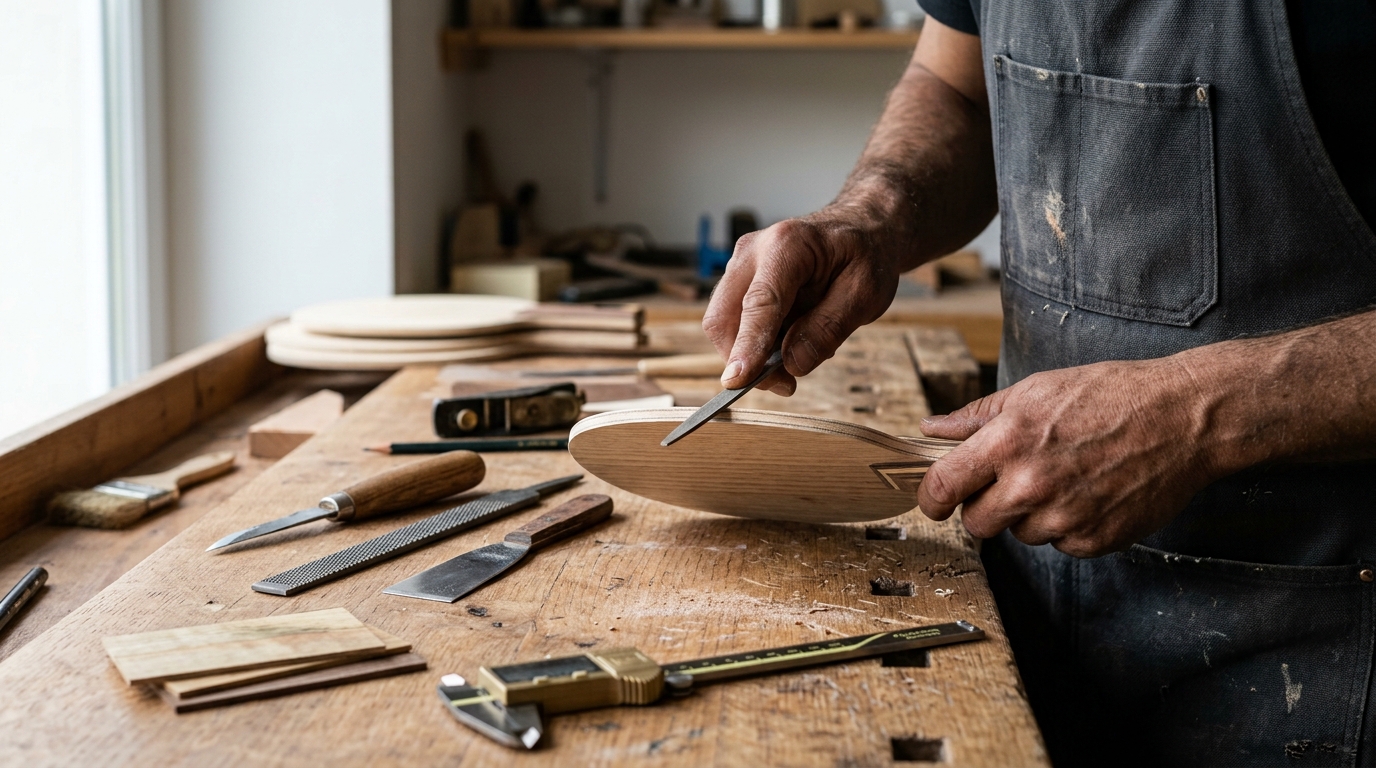
- Mastery of thicknesses to the tenth of a millimeter
- Piece-by-piece weight and balance control
- Pursuit of a coherent vibrational signature
- Handle work as a functional element, and not solely an ergonomic one
The artisanal gesture remains present, but it is placed at the service of a precise technical objective.
Concrete application at Mamba Blades
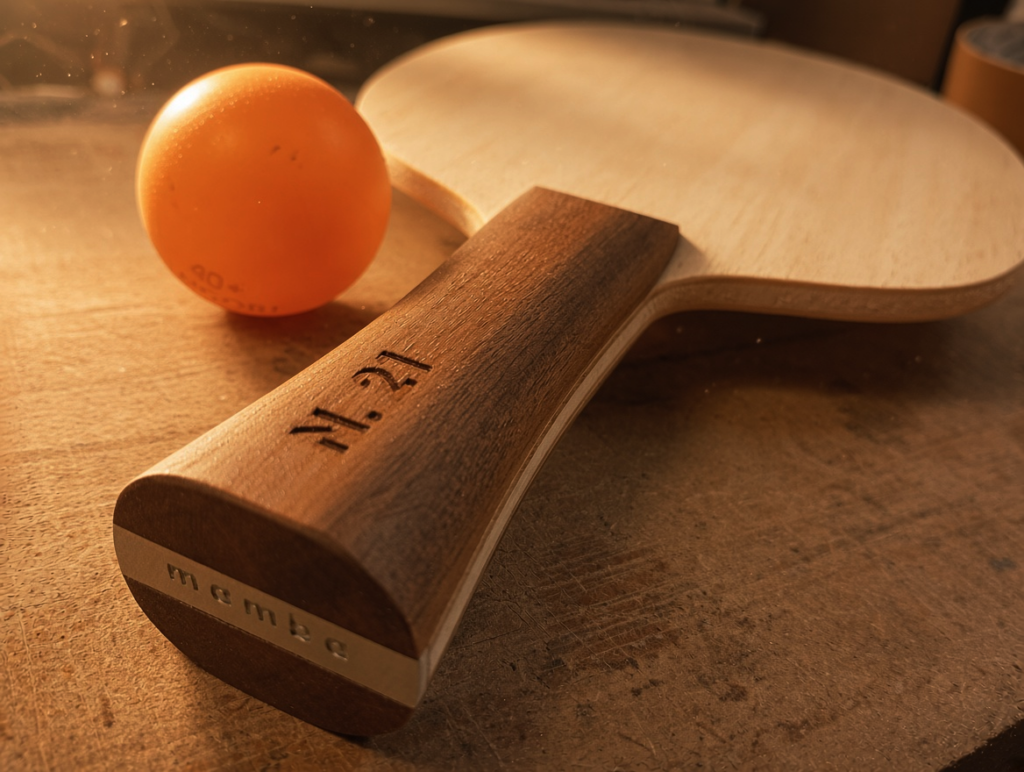
At Mamba Blades, each blade is approached as a single unit.
Cela implique :
- A selection of plies according to the desired behavior (control, projection, versatility, etc.)
- Particular attention to the blade-to-handle transition, a critical zone for vibration transmission
- Precise work on the handle (shape, cross-sections, finish) to stabilize the grip and influence the final balance
- Individual control of the main characteristics before validation
When reinforcements are used (flax, hemp, basalt, or BLC), they are not added to ‘stiffen as a rule,’ but rather to modify the wood’s response in a targeted manner.
Consequences for the player
A Sports Lutherie approach results in perceptible effects:
- Clearer feedback upon impact
- Greater legibility of the trajectory
- Greater consistency between strokes
- A more stable balance between dynamism and control
- A more ‘accurate’ overall feel, less random
The blade ceases to be a passive element.
It becomes a precise intermediary between the player’s intent and the ball’s behavior.
Technical conclusion
Sports Lutherie is not a marketing formula.
It is a design method that imports principles from instrument making into table tennis: listening to the material, controlling mechanical parameters, and pursuing a coherent response.
At Mamba Blades, this requirement guides every step, from wood species selection all the way to the final inspection of the piece.


